“The sea, is the great unifier, is man’s only hope. Now, as never before, the old phrase has a literal meaning: we are all in the same boat.” – Jacques-Yves Cousteau
SCUBA Diving the Pelorus Island express is not taking a train trip to your dive site. For those in the know, it is an illusive current that provides the most exhilarating underwater adventure on the reef.
To jump into the warm tropical water on the Great Barrier Reef, just near the golden beaches of a deserted tropical island, is truly one of the most magical experiences on the planet. With its crystal clear azure waters, brilliantly colourful coral and diversity of fish and all manner of sea creatures. They invite exploration and adventure.
SCUBA Diving the Pelorus Island Express is an opportunity to drift dive one of the most unknown coral reefs in the Great Barrier Reef Lagoon. Pelorus Island is a small island at the northern end of the Palm Island group, just off the coast of Ingham, in North Queensland. It is unknown because the express is not constant, it only appears in certain tidal conditions.
Nature finds a use for everything
It is therefore perplexing as to why anybody would want to spoil these bastions of diversity and marvels of nature. Who would dump a rusty old barbecue on a pristine coral reef….WTF. But there it was, in fifteen metres of water, completely the right way up, looking like all we needed to do was fire it up and throw the snags on the hot plate. To be honest, if we weren’t SCUBA Diving the Pelorus Island Express, we may never have discovered it.
I don’t really blame anyone for just pushing it off the back of their boat, after all there’s nothing there but sand right……right? From my perspective we should not discount the proposition that large items like this can actually help our reefs, not hinder them, anything that makes a safe haven for small fish is always a good thing. We weren’t expecting to do a drift dive when we assembled at the dive shop at six in the morning to catch a ride to Lucinda, where we would meet our dive crew for the day.
The wonders of the ocean
I first put my head underwater to look around when I was 12 years old. The world I saw then was completely foreign to me, and I was awe struck by its diversity. Only a metre underwater, and you were in a whole new world, I was an avid fan of Jacques Cousteau and his sons. Their adventures on the Calypso were legendary and inspired me to explore the oceans.
From then to now, I see new and wondrous things every time I go underwater, but I wasn’t expecting to see a rusty barbecue, encrusted with coral and algae. These man made disposable objects now complex homes, like public housing for sea creatures. The BBQ sits there, silent, unmoving and completely ignored.

Found this BBQ at 15 metres near Pelorus Island
That is, until a group of divers comes floating by in the current. Did I say “floating” well it was more like flying. We had gone out to Pelorus Island, which is the small island at the northern end of the Palm Island Group, just off from the famous Hinchinbrook Island near Lucinda in North Queensland.
The longest trestle in Queensland
It’s not long before we arrive at Lucinda and the crew from dive team leave us as they prepare the boat and gear we will need for this trip. It isn’t long before we are mustered to the boat and given both a safety briefing.
We assemble our gear, pack into the dive boat and head out along the longest trestle in Queensland before heading into the open sea towards the Palm Island Group of islands.

The end of the sugar jetty at Lucinda
Drift Diving off Pelorus and Orpheus Island
Our first drift dive was in a strong current in between Pelorus and Orpheus Islands. The visibility was approximately 10 metres when we started, but as we moved further into the channel it dropped to about three metres.

Divers taking slow kicks to maintain their position in the water column as they are pushed along by the current.
Generally, the current will run along the reef drop off, although this is not always a given and you can get caught in a stronger channel current and end up in the middle of a very turbulent choppy sea.
In a drift dive, you don’t have a point to navigate back to, and you don’t really appreciate how far you have gone. When you surface, it’s in the deep ocean, and you rarely have a point of reference from which to gain a position perspective. At these times, you rely on your buddy and your dive computer to ensure you don’t surface too fast.

Surfacing on a drift dive requires careful attention to buoyancy and use of your dive computer
Surfacing on a drift dive
Towards the end of a drift dive, you begin to surface slowly and maintain your buoyancy at your safety stop level, which is between six and four metres. During this time, you inflate and deploy your safety sausage. Hopefully, your dive boat captain isn’t far away by the time you surface. The role of the ship’s crew is critical to ensuring the diver’s safety and to make sure they don’t inadvertently run over you.
Mind you, I think I signed something saying that I accept that I might be run over while drift diving and that I don’t hold the dive crew responsible……that was fortuitous:) Having surfaced in a rather choppy cross current I wasn’t sure that signing off on that was the most appropriate thing to have done now that there’s a very real possibility this could happen..

The crew of the awesome Coral Gypsy waiting upon our return
Drift Diving at Pelorus Island
The advantage of a drift dive is that it allows you to cover more reef with less effort. There is no swimming against the current or battling surges, which takes energy and therefore more air. The disadvantages are that you have to maintain your buoyancy and profile in the water more accurately than you would normally, and it’s difficult to stop and explore.

Seeking baby sharks
You probably already know this, but most sharks do not give birth to live babies, except for a couple of breads, sharks deposit their young in pods in safe areas like Mangrove patches where they can hide from predators until they are big enough to venture into the open sea.
Pelorus Island has many such habitats, and we took the opportunity while degassing from our first dive to snorkel into these unique and wondrous habitats. Usually, exploring Mangrove habitats while snorkelling is a dangerous activity. This is because Mangroves are often in murky areas or up rivers which contain all sorts of predatory animals, the most dangerous of which are giant Saltwater Crocodiles and Bull Sharks. So having an opportunity to snorkel on and around Mangrove roots at high tide is a treat and as it was shark breeding time, we took the opportunity to go “Shark Seeking”.


Avoiding shallow water knock out
The dive boat was moored in eight meters of water, so during our surface interval where we reduce the nitrogen in our bodies, we decided to snorkel across from the boat to the shore. Due to the nitrogen build up in our bodies, we were unable to duck dive lest we pass out from lack of oxygen.
To avoid this, so while the swim across to the Mangroves has a huge amount of coral and brightly coloured fish, and it would be awesome to dive and explore the massive coral bommies, we had to be content with a view from the surface.

On our second drift dive we were exploring an area that is rarely dived, not because it’s difficult to get to but because it only occurs on certain tidal flows. The timing of these tidal flows has to be during the day and at times when divers are available. The express is also susceptible to poor visibility, so a high tide drive on a slightly outgoing tide is required. The Pelorus Express is at the Northern point of Pelorus Island.
The Drift
Visibility was approximately 10 metres and the current was between three and five knots. The current was slightly stronger than the first dive and, we dived slightly shallower along the reef wall, reaching a depth of 15.4 metres. This coral reef system went for approximately 10 kilometres.

It’s more like flying than diving
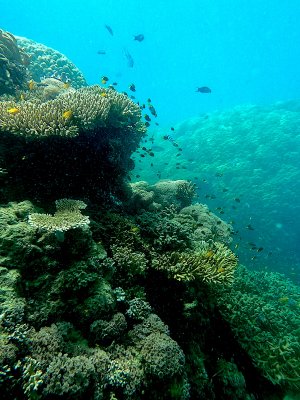
We glided past fan corals, soft and hard, and an array of multicoloured sponges. At times, it felt like we were flying, the closer we navigated to the reef wall the faster we went and the more spectacular the experience.


During the journey we came across an abundant variety of corals, fans, sponges and multi coloured fish. We saw turtles, coral trout and shovel nose sharks. So divers even mentioned a mermaid, but I find that hard to believe.

Drift diving as an advanced diver skill
Drift diving is one of the most interesting SCUBA diving activities you can do because you have more time to concentrate on what’s around you rather than fighting the current or having to navigate to a fixed point. You drift by as and innocent observer in a world that is foreign and unique. But all things must come to an end and with gas getting to 70 bar we had to surface.
The journey to the surface requires us to perform a safety stop between six and four meters for approximately four minutes. With our dive computers beeping if we come up too fast and then letting us know when we can take the final ascent to the surface. We busy ourselves preparing the safety marker and launch it from the safety stop. Our drift dive was spectacular and, I will always remember SCUBA Diving the Pelorus Island with fondness, hopefully I can do it again some time.
The dive boat is not too far away, and we are soon back on board jabbering about the different fish and corals and how awesome it was. Liam tells everybody about the BBQ he saw at 15 metres. Is it worth the wait to SCUBA Diving the Pelorus Island Express, you bet it is.
Touring Queensland
If you’re interested in Queensland’s beach and ocean scene, check out my post on Queensland’s top 12 beaches: Top 12 Beaches. I look forward to seeing you out there exploring the beautiful tropical landscap.
If you are interested in exploring other parts of Queensland you can check out my book: Gun Fights, Ghosts and Goannas. Safe travels and I’ll see you on the road (or in the water)…….Swaggie🙂
3 Responses
very cool Gazza
What a cool read Gary!!! I didn’t realise it was your blog post until seeing Liam!!! Your drift dive sounds like awesome fun!
Thanks Jordan. It was a pretty cool dive:)